
If you're facing a front tooth gap you've been covering up in every photo, Dentist Open Now lines up a Fenton, MO provider who handles this exact procedure regularly — not as a side offering.
One call gets you matched with a specialist and a confirmed time — not a callback promise.
+1-866-227-2801 Call Now
Losing a tooth changes more than your smile — it changes how you chew, how your jawbone holds its shape, and eventually how your other teeth start to shift into the gap. An implant fuses directly into the jawbone through osseointegration, giving you something a bridge or partial can't: a replacement root, not just a replacement tooth.
Every case starts with a CBCT scan so the specialist knows bone volume and nerve position before the surgical guide is even made. For patients with lower bone density, bone grafting or a sinus lift is scoped out during that same consultation — not discovered mid-surgery.
Healing time before the crown goes on typically runs three to six months, since the implant needs to fuse solidly with the bone before it can bear normal chewing force. A temporary tooth usually covers the gap during that healing window so you're not left with a visible space.
Placement is handled by periodontists or oral surgeons with specific implant-surgery training, not a general dentist doing it occasionally.
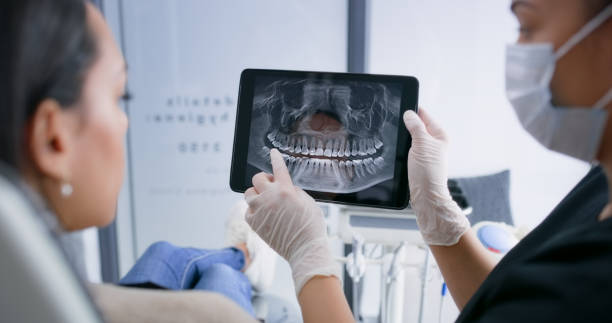
Cone-beam CT imaging maps your jawbone in three dimensions before the surgical guide is fabricated.
Consultation, placement, healing abutment, and final crown are each priced separately so you know what you're paying for at every step.
Offices in the network can perform grafting procedures in the same practice, avoiding a second referral chain.
Whatever the specifics of your case, the specialist you reach through us has handled it before.
A titanium post replaces the root, topped with a custom porcelain crown matched to your bite and shade.
Two or more implants anchor a fixed bridge, ideal when several adjacent teeth are missing.
Patients missing most or all teeth in an arch can often avoid a full graft with the All-on-4 approach.
Traditional dentures that slip get snapped onto two to four implants for a stable, non-slip fit.

Rebuilds bone volume in the jaw or lifts the sinus floor to create room for implant placement.
Some patients leave with a temporary tooth in place the day of implant placement, swapped for the permanent crown later.
You describe what's going on; no automated menu, no long hold.
Based on your case and location in Fenton, MO, we find a provider with room on the schedule soon.
The specialist examines your case, often with same-visit X-rays, and gives you a cost estimate before starting anything.
Treatment proceeds on the agreed plan, with clear aftercare instructions and a follow-up if the case calls for one.
"They walked me through the cost and the procedure before I agreed to anything. Appreciated that."
"Got in faster than I expected for something this specific. Staff were sharp and direct."
"No upsells, no pressure. Just the treatment I needed at the price I was told."
Most cases run three to six months total, mainly waiting for the bone to fuse to the implant post before the crown goes on.
Placement is done under local anesthesia, and most patients describe recovery discomfort as similar to a tooth extraction.
Low bone density doesn't automatically rule out implants — grafting is a common first step for many patients.
Pricing depends on the number of implants and any bone work required, and it's broken down for you before treatment starts.
An implant replaces the tooth root directly in the jawbone, while a bridge anchors to the neighboring natural teeth instead.
With proper hygiene and regular checkups, implants commonly last twenty years or longer, often a lifetime.
Our coverage spans Fenton and its surrounding area, matching you with the closest available specialist.
Every provider carries an active MO dental license, verified before referral.
A short phone call is all it takes to get this on the calendar this week.
Call +1-866-227-2801 Now